Set Pieces: Defending Wide Free Kicks in Modern Football
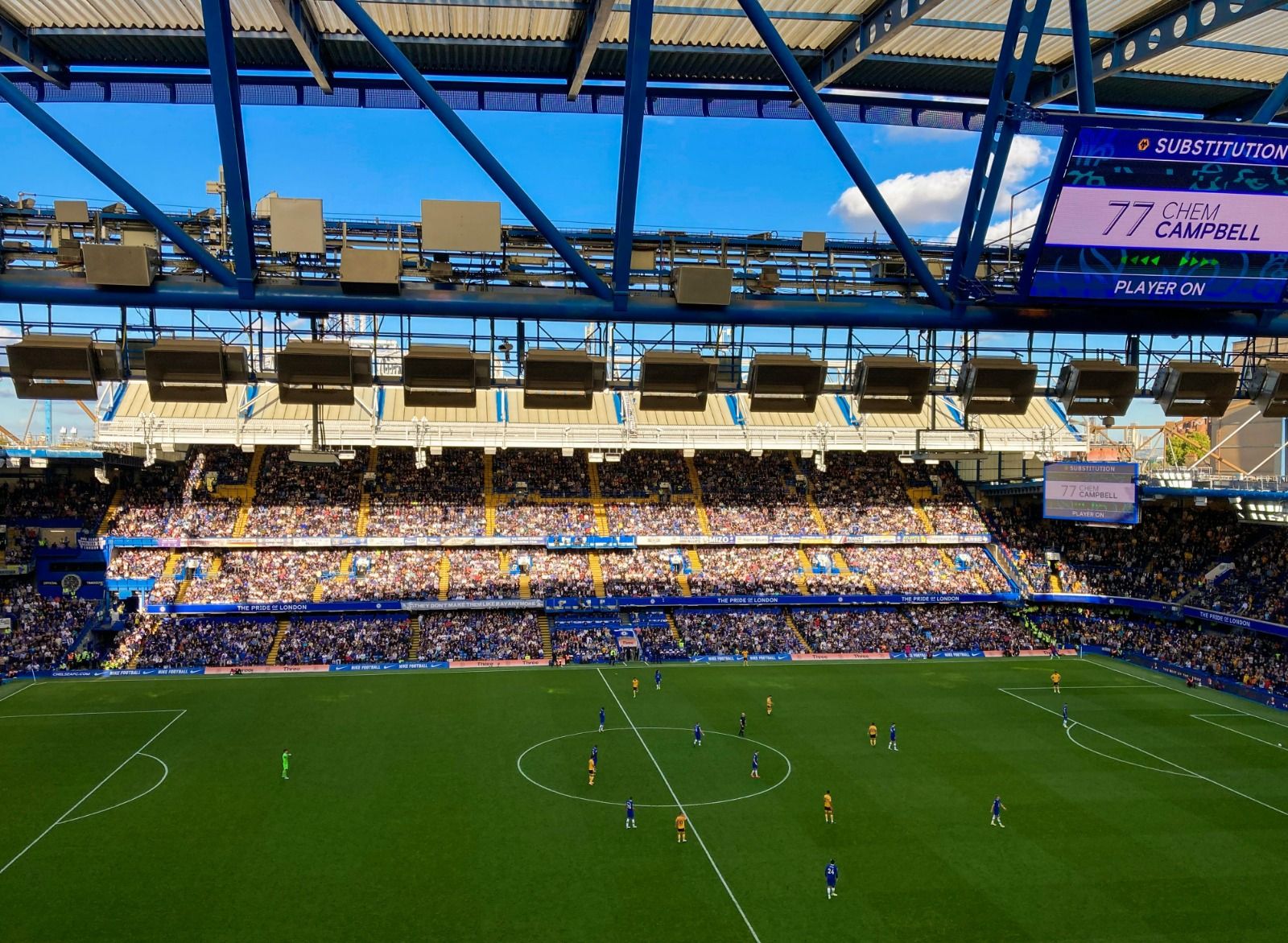
When Details Make the Difference
In today’s football, the differences between teams are increasingly subtle. Teams are more compact, better organized, and players are more physically prepared. In this context, creating chances from open play is becoming increasingly difficult.
For this reason, set pieces are playing an increasingly decisive role.
Data shows that approximately 30–40% of goals come from set-piece situations. This means that a significant part of the final result is decided in static moments that may appear simple, but are actually extremely complex from both a tactical and mental perspective.
Among these situations, defending wide free kicks is one of the most delicate moments for a team.
In these situations, two main defensive approaches emerge:
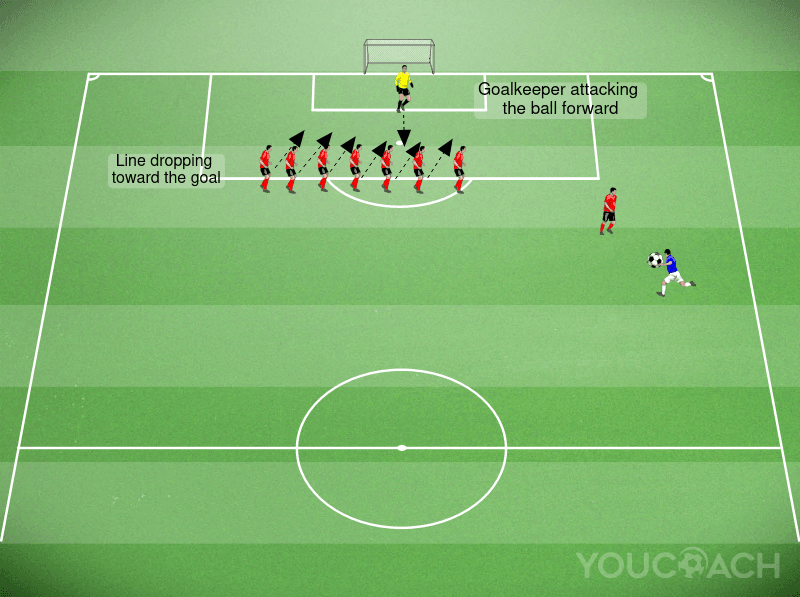
- The defensive line dropping toward the goal
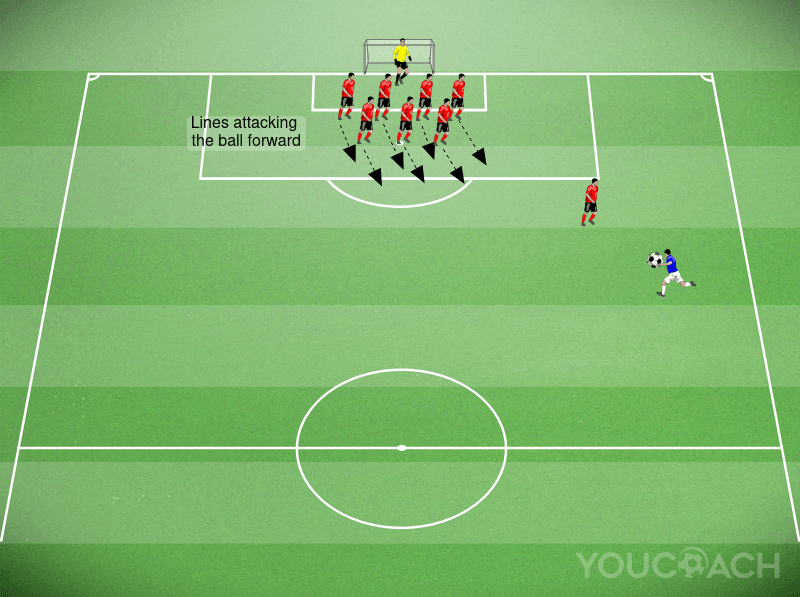
- The defensive structure attacking the ball forward
Two different choices, both valid, but with different characteristics, advantages, and potential risks.

The Defensive Line Dropping Toward the Goal
This is probably the most common system, both in elite football and at amateur level.
The defensive line takes the ball as its reference point and, at the moment of delivery, drops toward its own goal, trying to keep the penalty area clear and facilitate the goalkeeper’s intervention.
This type of defense allows teams to:
- Clear the penalty area from opponents
- Create space for the goalkeeper to come out
- Avoid static duels inside the box
However, this system requires great attention and synchronization. The defensive line must move in a coordinated and unified way, paying particular attention to:
- Reading the moment of delivery
- Distances between defenders
- Body posture
- Communication with the goalkeeper
The goalkeeper also assumes a decisive role. He must be able to read the trajectory and show confidence when coming off his line.
The Risks
Despite being the most widely used system, it presents some important risks.
The taker has the possibility to deliver a driven ball behind the defensive line. In these situations, the goalkeeper often has to come out into a crowded area, with both teammates and opponents, making the intervention complex not only technically but also mentally.
Another aspect concerns movement dynamics: defenders drop laterally toward the goal, while attackers attack the space frontally. This often creates a dynamic advantage for the attackers.
In these situations, even a few centimeters or fractions of a second can make the difference.
The Structure Attacking the Ball Forward
An alternative approach is defending with a structure that attacks the ball forward.
In this case, two defensive lines are generally formed inside the penalty area, which attack the ball frontally at the moment of delivery.
It is also possible to use a mixed solution:
- First line zonal, attacking the ball
- Second line marking or contesting
This type of defense allows defenders to see the ball more clearly and attack it frontally, facilitating the intervention.
This approach encourages a more aggressive and proactive defense, reducing the attackers’ dynamic advantage.
The Risks
The main risk is the concentration of many players inside the penalty area. In these situations, deflections or rebounds can become difficult to manage.
The goalkeeper must also be comfortable coming out in crowded and chaotic situations, where reading the trajectory becomes more complex.
The Role of the Wall
One often underestimated aspect in wide free kicks is the role of the wall.
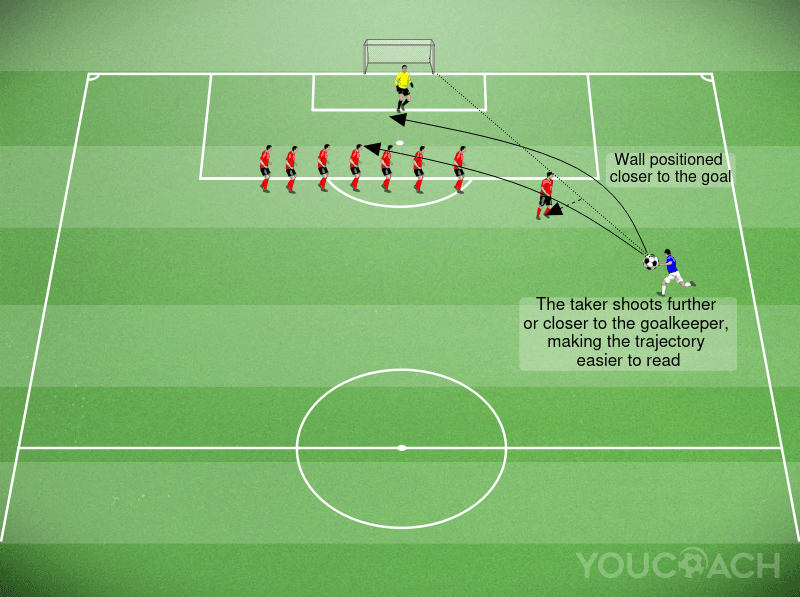
When defending with a line dropping toward the goal, the main danger is a strong, driven ball over the first defender.
For this reason, the position of the player in the wall becomes crucial.
It is preferable to position the player slightly toward the center of the goal, rather than perfectly aligned with the post. This reduces the taker's available delivery area, forcing them to choose between a softer ball, one further from the goalkeeper, or one closer to him. In each of these cases, the trajectory becomes more readable for both the goalkeeper and defenders.
This is another seemingly small detail that can significantly impact defensive effectiveness.
Posture: The Details That Make the Difference
As often happens in set pieces, details become decisive.
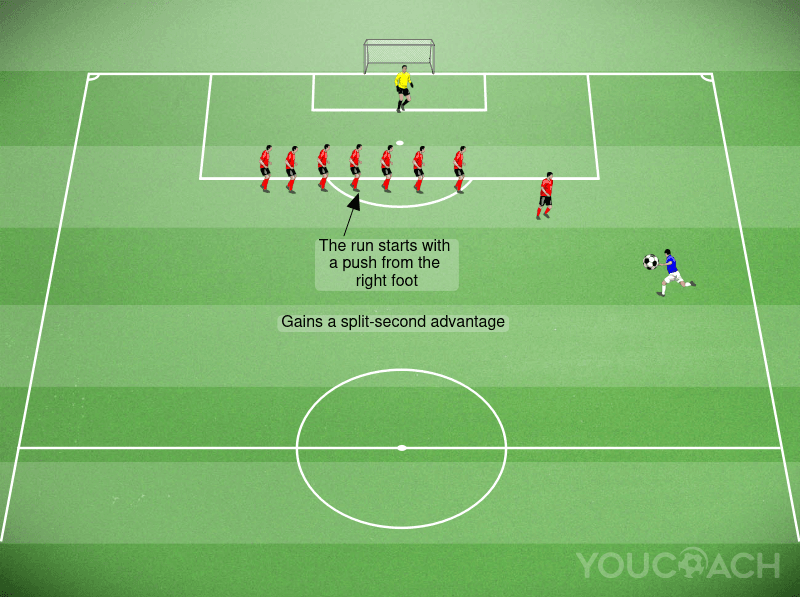
In the case of a defensive line dropping toward goal, foot positioning is fundamental to reduce reaction time.
For a wide free kick from the defending team’s left side:
- The left foot is oriented toward the goal
- Body weight is on the right foot
- The push comes from the right foot
This posture allows for a one-time start.
An incorrect weight distribution leads to slower reaction time and, in these situations, even a fraction of a second can be decisive.
Posture in the Double Line
When defending with a double line attacking the ball, posture changes.
Players must:
- Stay on their toes
- Be active
- Be ready to jump
They must also be prepared to jump from a standing position and under pressure from opponents.
This requires:
- Jumping ability
- Timing
Coordination
Training Wide Free Kicks
Wide free kicks represent situations that are difficult to manage without specific training. Line synchronization, defenders’ posture, communication between players, and the goalkeeper’s role are all aspects that require attention to detail and consistent training.
In particular, when defending with a line dropping toward goal, it becomes essential to work on timing and movement coordination. Conversely, when defending by attacking the ball forward, the focus shifts more toward jumping ability, aggressiveness, and second-ball management.
Only through situational training and repetition of these dynamics is it possible to improve the management of wide free kicks and reduce unpredictability.
There Is No Perfect System
There is no perfect system for defending wide free kicks.
There is only the system that best fits the characteristics of the team, the goalkeeper, and the defenders.
Some teams will prefer to drop toward the goal, others to attack the ball forward.
The real difference, however, is not the system itself, but attention to detail, quality of training, and players’ conviction.
Because in modern football, increasingly balanced, set pieces — and the details that accompany them — often determine the final result.
And You?
Every context requires specific evaluations and decisions. Comparing approaches, sharing experiences, and analyzing different solutions can represent a growth opportunity for every coach.
What approach do you use with your team when defending wide free kicks? Have you found particularly effective solutions based on your players’ characteristics?
Sharing ideas and experiences can help improve attention to detail and, consequently, the management of increasingly decisive situations in modern football.
<u>Tactical images created with: https://www.youcoach.com/</u>
Related articles
Latest about ⚽ Tactics
See all
When Play Becomes Method
⚽ TacticsOver the course of a football season, not all training sessions carry the same weight, intensity, or emotional load.
Defensive Reading in Modern Football: Beyond Free Ball and Covered Ball
⚽ TacticsIn modern football, where spaces vanish in seconds and every decision can change the outcome of a match, the defensive line has a crucial task: reading the signals of the game.